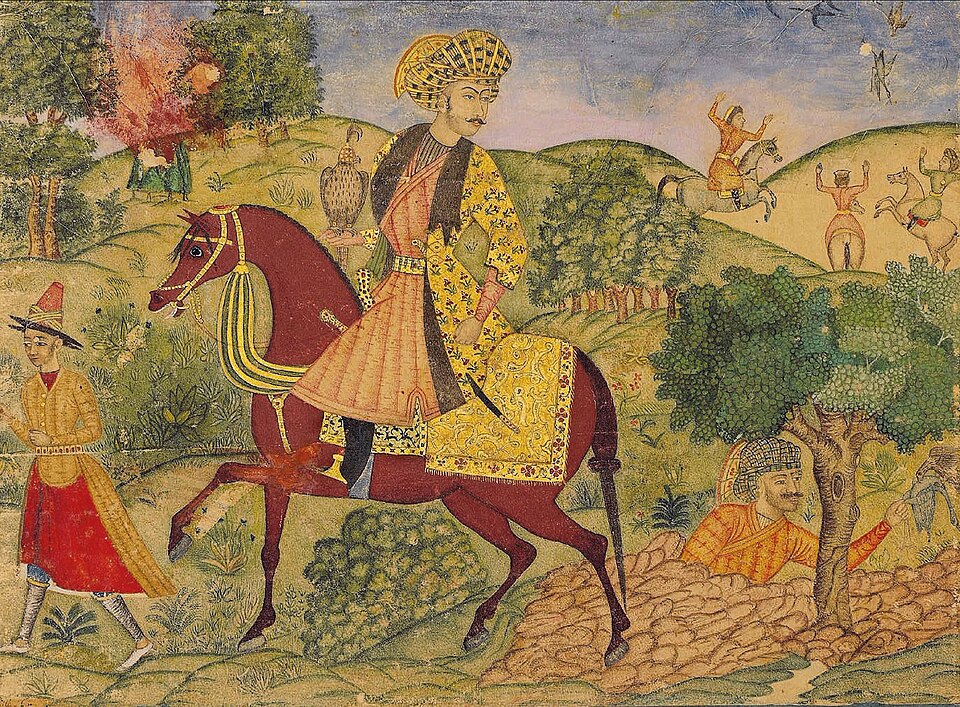
anglo-indisk hætte #
Falconry terms
A hood cut from a pattern, with ample room around the eyes and a large beak opening. It is a good first hood to sew yourself.
See also: hætte (falkehætte)
Sources: MA
123 Danish terms about birds of prey and falconry, explained in English, with word histories and words from around the world.
Falconers have a language of their own. Many of its words are several hundred years old, and the same pieces of equipment have names in Arabic, Japanese, Spanish and many other languages. Falconry is inscribed on UNESCO's list of the Intangible Cultural Heritage of Humanity as a living tradition shared by many countries (UNESCO).
This dictionary gathers the Danish falconry terms, ornithological words and biological concepts you will meet at our demonstrations and in our articles. The headwords are the Danish words we use at Eagle World. Each entry explains the term in English, gives the English word in brackets where it is documented, and lists its sources and, where it can be documented, the history of the English word.
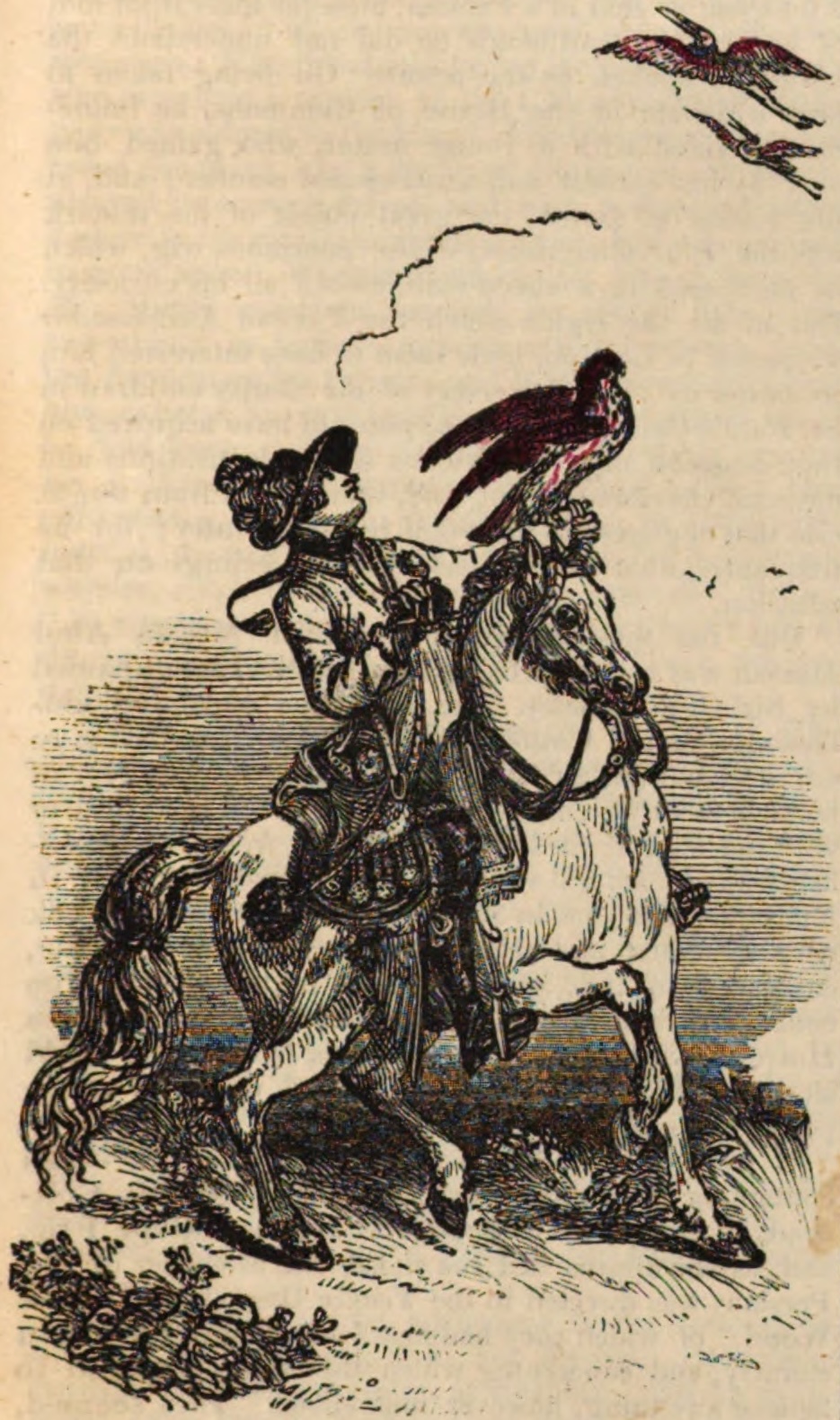
The language of falconry is a craft language, a jargon, that grew up at the medieval courts, where hunting with falcons was the most distinguished form of hunting among the nobility. In the 13th century Emperor Frederick II wrote the great Latin work De arte venandi cum avibus ("On the art of hunting with birds"), which describes the birds, the equipment and the training in detail (Wood & Fyfe translation). In England, The Boke of Saint Albans was printed in 1486 with a section on hawking, and it helped to fix many English terms of the craft.
In the German Jägersprache (hunters' language) the language of falconry lives on as a branch of its own, with special words for the bird's body and behaviour. The feet of a falcon are called 'Hände', the tail 'Stoß' and the droppings 'Schmelz' (DFO, ODF). Many of these words are still used by falconers today.
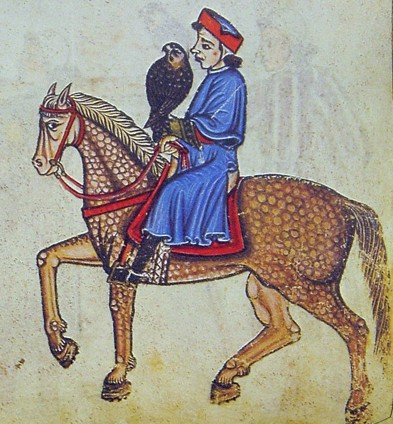
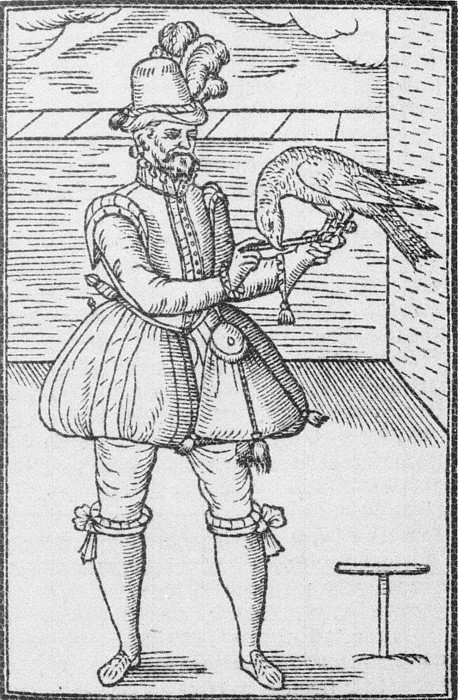
The words have followed the birds and the falconers across borders. From Latin falco and Medieval Latin falconarius they reached English through French: faucon became falcon, fauconier became falconer, and Old French jes and loirre became jess and lure (Etymonline). Danish took many words from the south; according to Den Danske Ordbog, falk, blok and kro come from Middle Low German.
From the 16th century the Dutch falconers, above all those of Valkenswaard, led the way in Europe. According to the Deutscher Falkenorden, German falconry language is therefore largely built on Dutch and Flemish words (DFO).
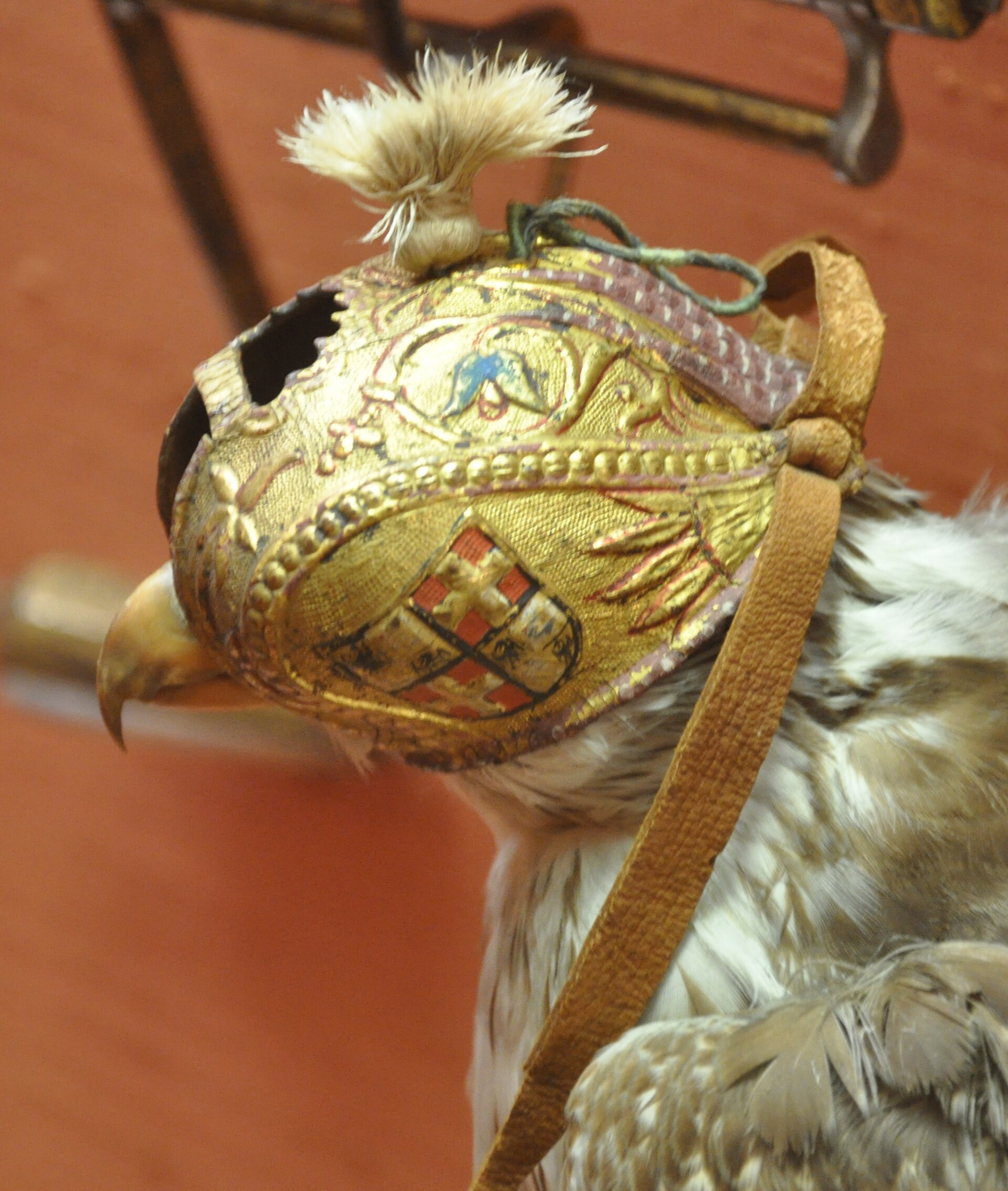
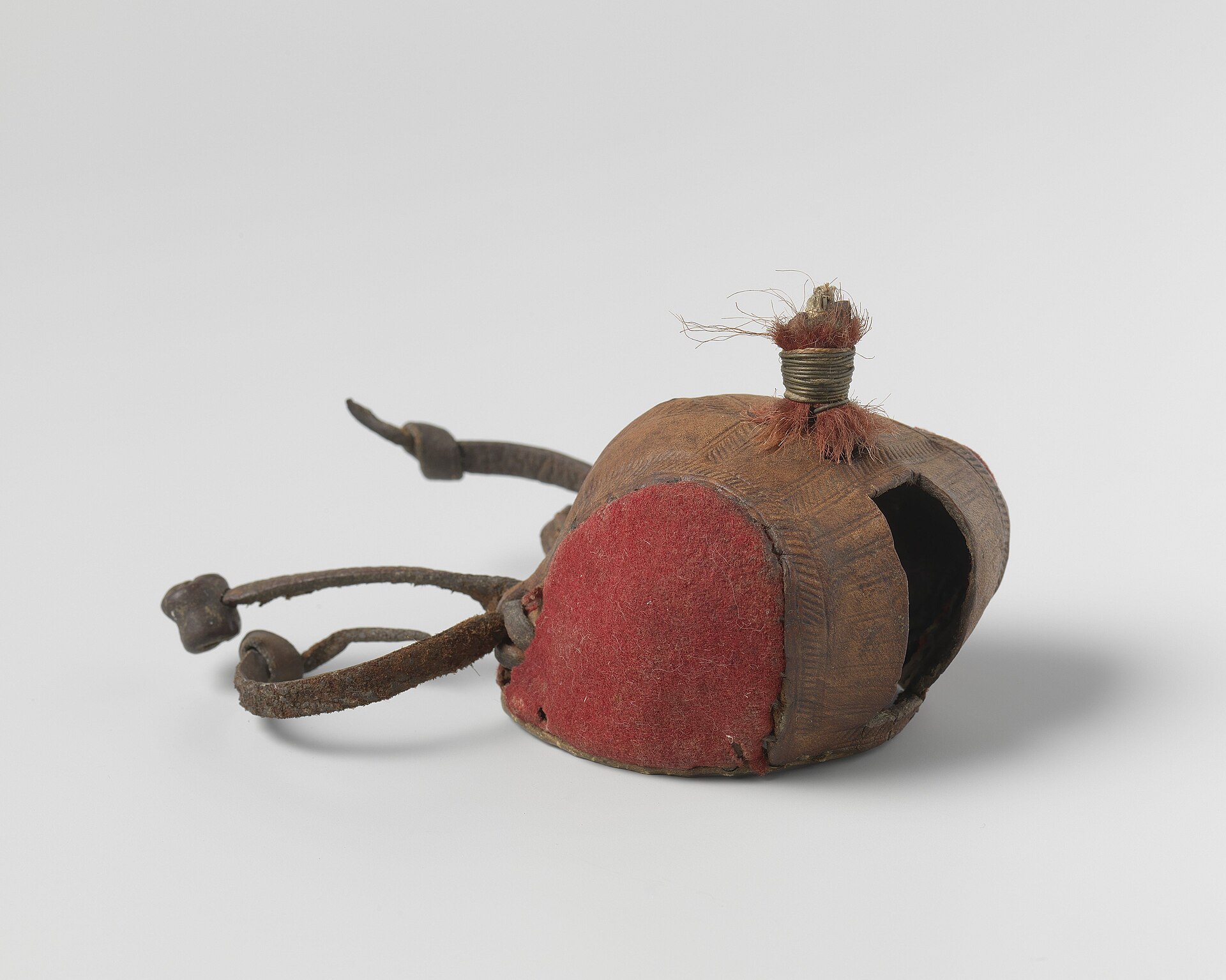
A hood cut from a pattern, with ample room around the eyes and a large beak opening. It is a good first hood to sew yourself.
See also: hætte (falkehætte)
Sources: MA
(EN slitless jesses (flying jesses))
Jesses that sit around the bird's ankle. Jesses with a slit are used when the bird is attached to the swivel; when it is to be flown, slitless jesses are fitted so nothing can snag.
See also: sko, dråle (svirvel), aylmeri-sko
Sources: MA
(EN Arab hood, Indian hood)
Two of the well-known hood types alongside the Dutch and Anglo-Indian. Like the Dutch hood, the Arab hood is shaped over a hood block and takes great experience to sew.
Read more: Falkehaetten et haandvaerk syet til en bestemt fugl
See also: hætte (falkehætte), hollandsk hætte
Sources:
(EN secondaries)
The inner flight feathers along the forearm. They mainly provide lift.
See also: svingfjer
(EN asynchronous hatching)
In many birds of prey the eggs hatch a few days apart, so the chicks in a brood differ in size.
See also: kuld
Sources: CORN
(EN to man, to train)
To train a bird of prey to work with the falconer, so it becomes confident, comes when called and can be flown at quarry. It takes patience and reward.
See also: at mande, tillid / samarbejde, indkald (at kalde fuglen ind)
(EN mantling /ˈmæntlɪŋ/)
The bird spreads its wings and tail over its quarry or food to hide it.
Word history: Mantle is from Latin mantellum 'cloak' (Etymonline).
See also: bytte / vildt
(EN free flight)
When the bird is flown without a line and returns to the falconer of its own accord.
Read more: Hvorfor flyver fuglene ikke vaek
See also: line / lang line, indkald (at kalde fuglen ind)
Sources: MA
(EN to feed)
German falconry word for the bird taking food by itself.
See also: kro, Atzung (tysk)
(EN manning /ˈmænɪŋ/)
To train a bird of prey: through calm daily contact the bird gets to know people, sounds and new surroundings and becomes confident with the falconer.
See also: at afrette, tillid / samarbejde
When a falcon climbs in circles to gain height.
See also: at vente kredsende
(EN incubate)
When the parent bird sits on the eggs and keeps them warm until they hatch.
Read more: Aeg livets lille mestervaerk
(EN to bind, to strike)
When the falcon grips the lure or quarry with its feet, the falconer says it 'strikes' (the lure). German falconry language uses 'binden' for falcons and 'greifen' for hawks and eagles.
See also: fanger / kløer
Sources: BDF
(EN bate, bating)
When the bird suddenly flies off the glove or block and hangs in its straps. It is often a sign of unease.
See also: at mande
The falcon waits, circling high above the falconer, until the quarry flushes, and then stoops from height.
See also: styrtdyk, at ringe op
(EN food, rations)
German falconry word for the bird's food. 'Atzen' means to feed.
See also: at kröpfen (tysk)
(EN austringer /ˈɒstrɪndʒə/)
English term for a falconer who flies hawks (shortwings) rather than falcons.
See also: falkoner, kortvinger og bredvinger
(EN Aylmeri jesses)
A modern jess system with a leather cuff (anklet) on the leg and an exchangeable strap through an eyelet. Named after Guy Aylmer.
Sources: MA
(EN bath)
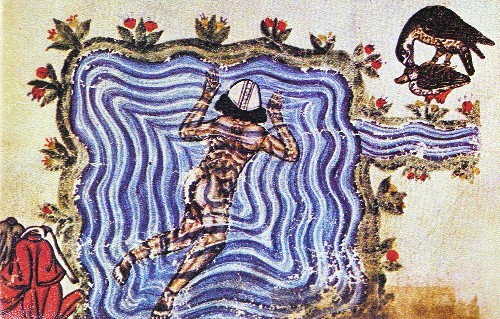
Birds must always be able to drink and bathe. A shallow tub of fresh water is an important part of feather care.
See also: lufteplads
(EN hawking)
German word for hunting with a trained bird of prey. According to the Deutscher Falkenorden it developed from 'Beißjagd' (biting hunt), because falcons kill with a bite to the neck.
See also: falkejagt / falkoneri
Sources: DFO
(EN bell)
A small bell on the leg or tail, so the falconer can hear the bird in tall grass or in a tree.
See also: sporingsudstyr / pejling
(EN block (perch))
Perch for falcons and eagles: a padded top on a spike pushed into the ground. The block should match the size of the bird.
See also: bue / høgebue, langrem
(EN lost bird)
A bird that has flown off and not returned. It is searched for with tracking equipment, and good preparation makes the search easier.
Read more: Hvorfor flyver fuglene ikke vaek
See also: sporingsudstyr / pejling, bjælde
Sources: MA
(EN bow perch)
A curved perch with two spikes, used especially for hawks and buzzards. It should be high enough for the tail to clear the ground. Also called 'bøjle' in Danish.
See also: blok
Sources: MA
(EN quarry, prey)
The animal the bird of prey hunts. In falconry, quarry is taken in its natural habitat.
See also: falkejagt / falkoneri
(EN DDT, eggshell thinning)
The pesticide DDT thinned eggshells and caused, among others, peregrine populations to decline in the 20th century.
See also: vandrefalk, æg
Sources: PF
(EN swivel)
A double swivelling metal ring between jesses and leash. It stops the straps from twisting.
(EN rabbit lure, dummy)
A lure shaped like a hare or rabbit that is dragged across the ground. It is used for hawks, buzzards and eagles.
See also: lokke
(EN down)
Soft, insulating feathers close to the body. Young birds of prey are first covered in down.
See also: unge
(EN coverts)
Smaller feathers covering the bases of the flight and tail feathers, giving a smooth, aerodynamic surface.
See also: fjerdragt
(EN falcon)
Collective name for the pointed-winged birds of prey in the genus Falco, such as the peregrine, gyrfalcon and saker. In falconry, falcons are the 'longwings'.
Word history: From Old French faucon, from Late Latin falco; the further origin is not settled (Etymonline). Danish falk comes from Middle Low German valk(e) (DDO).
First recorded: Mid-13th century (Etymonline).
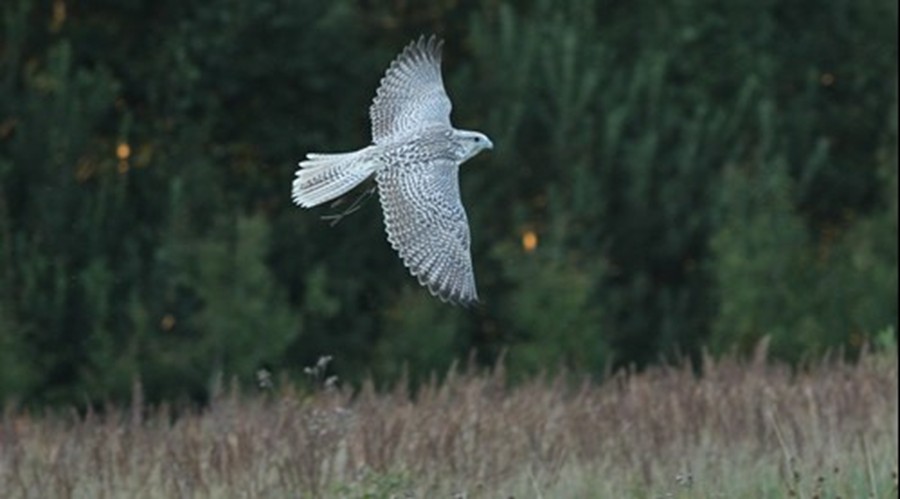
Read more: Vandrefalk falco peregrinus, Sakerfalk falco cherrug
See also: langvinger, terts / tercel (han), vandrefalk
(EN cadge)
A large frame on which several falcons can sit during transport and hunting. Today it is also made of plastic with artificial turf.
See also: blok
Sources: MA
(EN falconry, hawking)
Hunting wild quarry in its natural habitat with a trained bird of prey. Falconry is inscribed on UNESCO's list of the Intangible Cultural Heritage of Humanity and is shared by many countries.
Word history: Falconry from French fauconnerie (Etymonline).
First recorded: 1570s (Etymonline).
Read more: Da falkejagten blev til, Oernereservatet holder 5 000 aars kulturarv i live, Paa jagt uden skydevaaben
See also: falkoner, Beizjagd (tysk)
(EN lure)
A lure with feathers or wings that the falcon trains on and flies at. In German it is called Federspiel, and 'federspil' is seen in Danish as a German or older form.
See also: lokke
(EN falconer)
A person who keeps, trains and hunts with birds of prey. The work rests on daily care, patience and trust between person and bird.
Word history: From Old French fauconier, from Medieval Latin falconarius (Etymonline).
First recorded: As 'one who hunts with falcons' late 14th century; as a surname from the late 12th century (Etymonline).
Read more: Det at vaere falkoner, At vaere falkoner et haandvaerk med vinger verden over
See also: falkejagt / falkoneri, austringer
The falconer's knot is used to tie the leash, for example to the block, bow perch or glove, and every falconer must be able to tie it. The stop knot at the end of the leash stops it slipping through the swivel.
See also: langrem, dråle (svirvel)
Sources:
In Denmark you must pass an examination to obtain the falconry hunting licence, and only then may you hunt with a bird of prey.
Read more: Det at vaere falkoner
See also: falkoner, falkejagt / falkoneri
Sources:
(EN talons, feet)
The feet of a bird of prey with their curved, sharp claws, used to seize and hold quarry. Danish falconers call the talons 'fanger'.
Read more: Oernekloeer naturens ultimative grebsredskab
See also: handske / falkonerhandske, at slå (på lokken)
(EN plume, topknot)
The feather plume on top of a hood. It is both decoration and handle, so the hood can be removed with one hand.
See also: hætte (falkehætte)
Sources: BDF
(EN plumage)
All of a bird's feathers together. Many birds of prey change appearance from juvenile to adult plumage over several years.
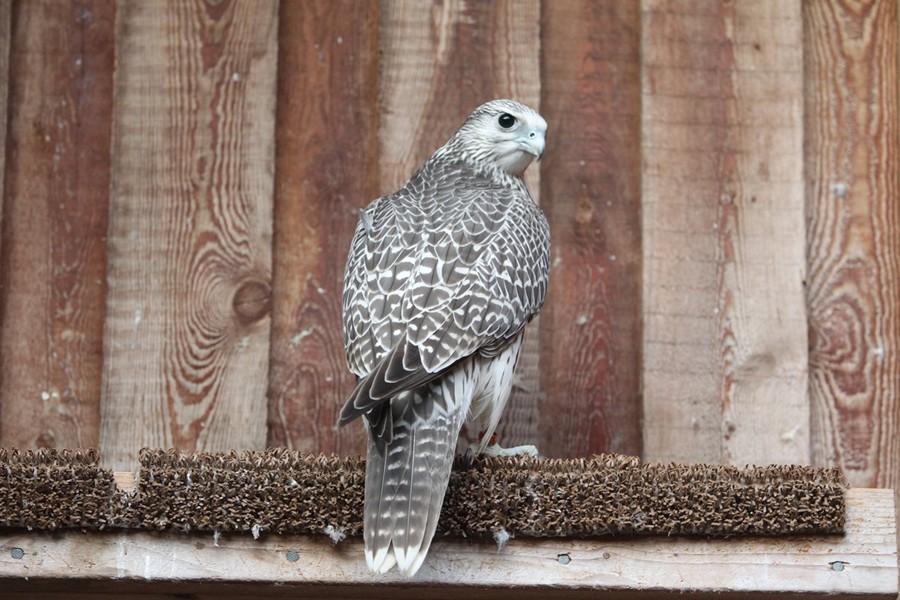
Read more: Fra fjerdragt til stjernestoev hvor meget forstaar vi egentlig
(EN imping)
Repairing a broken flight or tail feather with a previously moulted feather, a thin needle and glue.
See also: svingfjer, styrefjer / halefjer
The weight at which the bird is healthy, strong and motivated to fly and cooperate. The bird is weighed daily and the weight is noted in a log.
Read more: Hvornaar traener i egentlig jeres fugle og hvor tit
See also: vægt (vejning), kondition
Sources: MA
(EN moult (US: molt))
When the bird replaces its feathers. Birds of prey moult once a year, while eagles spread the moult over at least two years. During the moult the bird is normally not flown and gets especially good food.
Word history: Mew, the place where hawks were put to moult, comes from Old French mue, from muer 'to moult', Latin mutare 'to change' (Etymonline).
See also: mews (fældningsrum), svingfjer
(EN food chain, apex predator)
Birds of prey sit high in the food chain and therefore reflect the state of nature. Environmental toxins often accumulate in them.
Read more: De tavse draebere i foedekaeden
See also: rovdyr–byttedyr-forhold
Sources: PF
(EN reintroduction)
Releasing captive-bred birds where the species has disappeared or become rare, such as the peregrine in North America.
Read more: Genetablering af jagtfalken paa island
See also: opdræt i menneskers varetægt
Sources: PF
(EN tidbit, reward)
A piece of meat on the glove to which the bird is called.
See also: handske / falkonerhandske, indkald (at kalde fuglen ind)
Sources: ODF
(EN cast, pellet)
The casting is a ball of fur, feathers and bone that the bird cannot digest and therefore brings up. This usually happens 12–24 hours after a meal, and the bird must have cast before it is weighed and flown.
Read more: Myter og fakta om rovfugle
See also: klat / klatte, kro
(EN haggard /ˈhæɡəd/)
Historical falconers' term for an adult bird that has moulted in the wild. English haggard originally meant 'wild' of hawks.
Word history: From French hagard; the OED considers the often-cited derivation from a word for 'hedge, wood' very doubtful (Etymonline).
First recorded: 1560s, of hawks (Etymonline).
See also: redeunge (eyass)
Tracking equipment fitted to one of the tail feathers. The method is widely used on falcons.
See also: sporingsudstyr / pejling, styrefjer / halefjer
Sources:
(EN glove, gauntlet)
A sturdy leather glove on which the bird sits and which protects against its talons. The bird is traditionally carried on the left hand, leaving the right one free.
Word history: The Danish word comes from Low German hantsche or Old Saxon handskoh, literally 'hand shoe' (DDO).
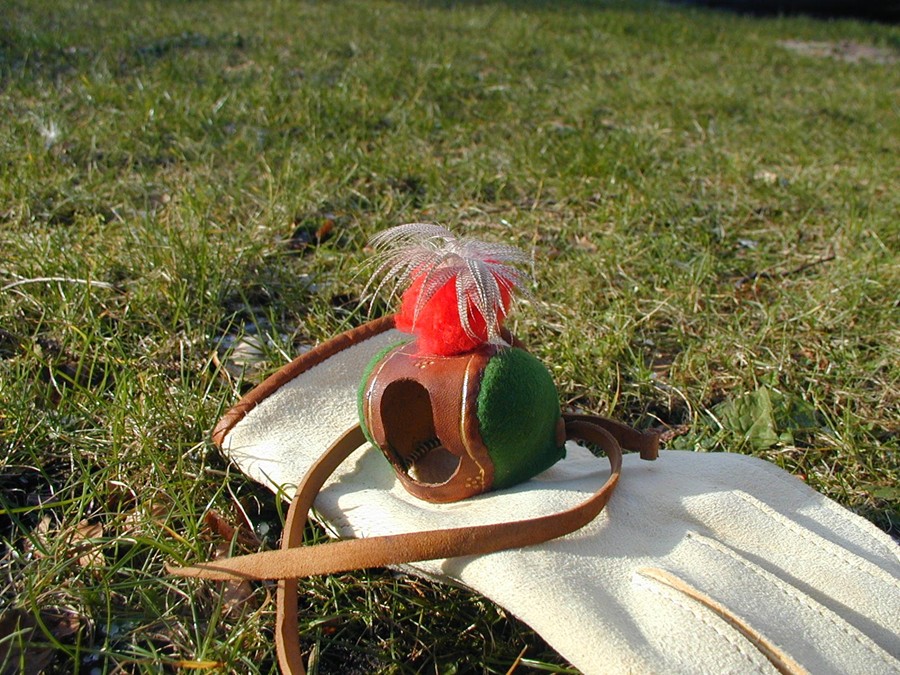
Read more: Hvorfor flyver fuglene ikke vaek
See also: fanger / kløer, sejlring (på handsken)
A hood sewn from several pieces of leather and shaped over a hood block. The type is associated with the Dutch falconers of Valkenswaard.
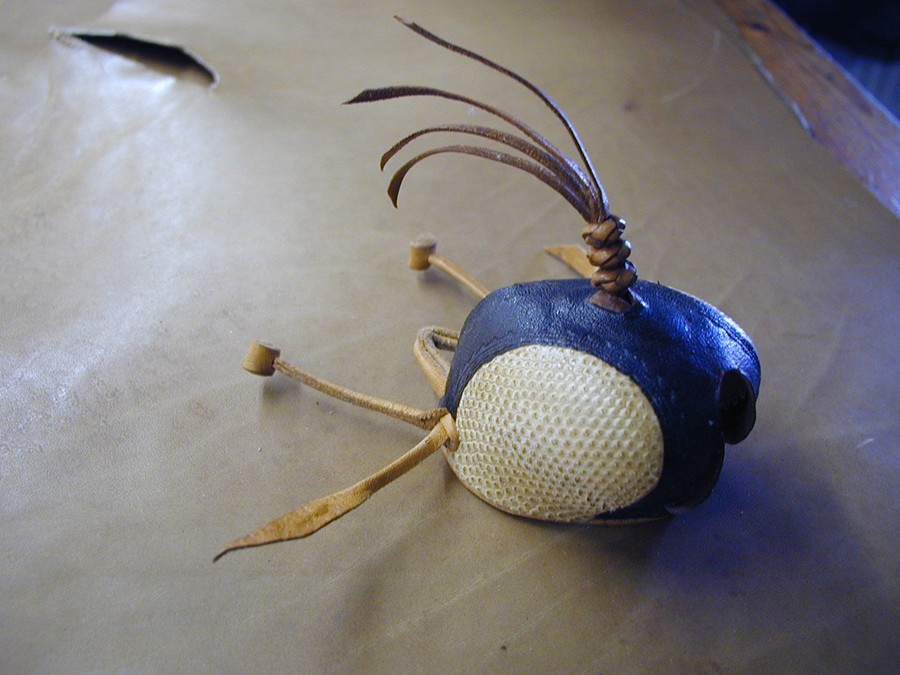
Read more: Falkehaetten et haandvaerk syet til en bestemt fugl
See also: hætte (falkehætte), hætteblok
Sources: MA
(EN eyrie (aerie) /ˈɪəri/)
The large nest of branches built by eagles, buzzards and hawks, often in tall trees. It is used and added to year after year.
Read more: Et sjaeldent syn i kongeoernens rede
See also: rede
(EN hood)
A leather hood that covers the bird's eyes and keeps it calm during transport and in busy surroundings. A good hood never touches the eyes and leaves the beak free.
Word history: Frederick II's falconry book calls the hood 'an invention of the Eastern peoples' (Wood & Fyfe 1943). Danish hætte is from Old Norse hetta (DDO).
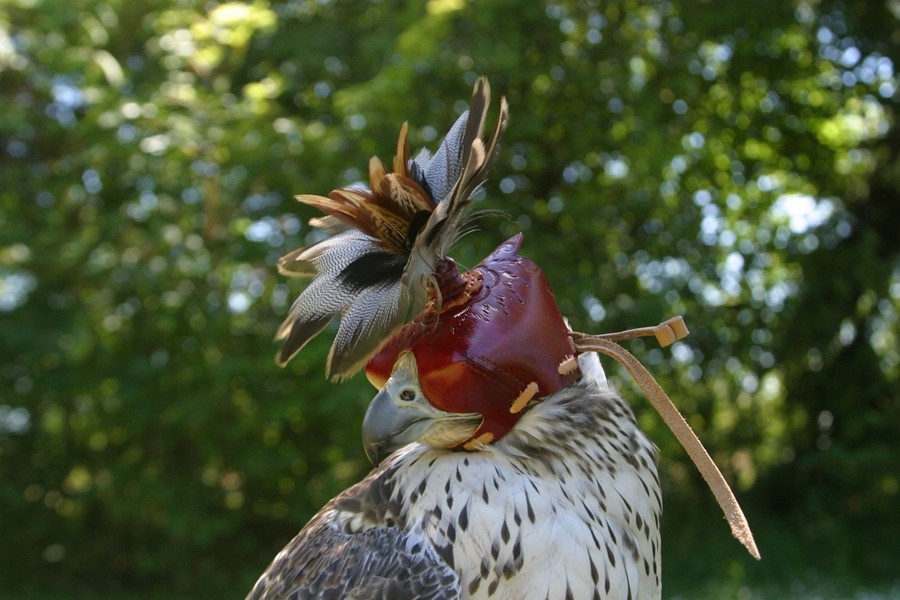
Read more: Falkehaetten et haandvaerk syet til en bestemt fugl
See also: hætteblok, anglo-indisk hætte, hollandsk hætte, fjerbusk (på hætten)
A wooden form in the shape of the bird's head, over which the leather of a hood is shaped.
See also: hætte (falkehætte), hollandsk hætte
Sources: MA
(EN hawk (goshawk, sparrowhawk))
Birds of prey with short, rounded wings and a long tail, such as the goshawk and sparrowhawk. They are built for fast hunting among trees.
See also: kortvinger og bredvinger
(EN asymmetrical ears)
Many owls have asymmetrically placed ears, allowing them to pinpoint where a sound comes from, even in darkness.
Read more: Ugleoererne kan du finde musen i moerket
See also: ugle
Sources: CORN
(EN primaries)
The outermost flight feathers, attached to the 'hand'. They provide most of the thrust.
See also: svingfjer
The bird flies to the falconer's glove or to the lure when called. It is the foundation for flying the bird free.
See also: lokke, at flyve frit
Daily notes on the bird's weight, performance, food and weather. Over time the log gives a good overview of the bird's condition.
See also: flyvevægt, vægt (vejning)
Sources:
(EN mute(s))
The bird's droppings. Falconers check them every day, as they reveal a great deal about the bird's health.
See also: gylp / gylpbolle
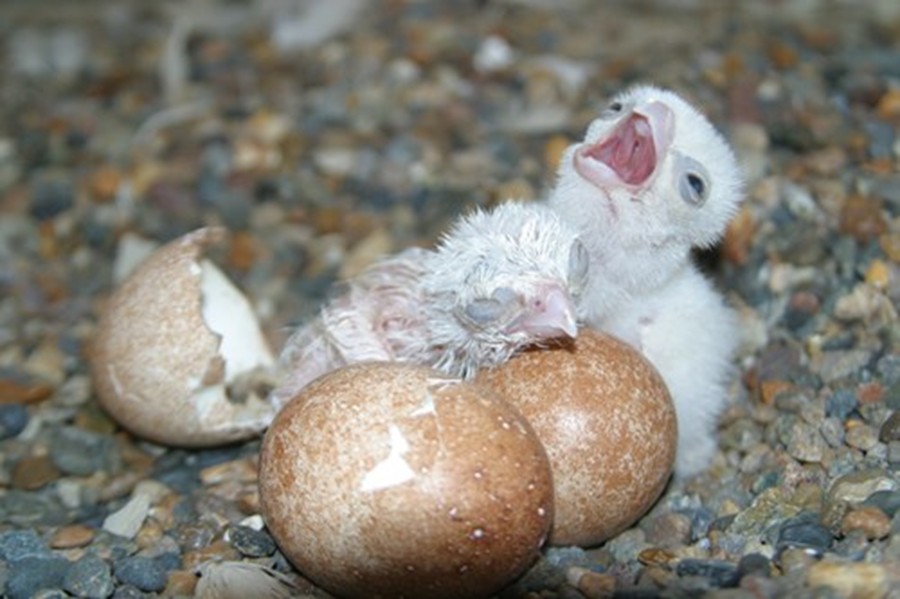
(EN hatching)
When the chick breaks out of the egg, using a small 'egg tooth' on its beak to chip a hole.
(EN condition)
The bird's physical condition: muscle, stamina and fat reserves. In English 'condition' can also mean how fat the bird is.
See also: flyvevægt
Sources: JRR
(EN sibling competition)
When the chicks in a brood differ in size, the largest often gets most food. In some eagles this can mean that only one chick survives.
See also: asynkron klækning
(EN shortwings, broadwings)
Shortwings are hawks such as the goshawk and sparrowhawk; broadwings are buzzards and eagles. They often hunt from the fist or from a perch.
See also: langvinger, austringer, høg
Sources: MA
(EN crop)
A pouch in the gullet where food collects before passing on to the stomach. Falconers speak of the bird having 'filled its crop'.
See also: at kröpfen (tysk)
(EN clutch (eggs), brood (young))
The eggs or young laid or hatched in the same breeding attempt.
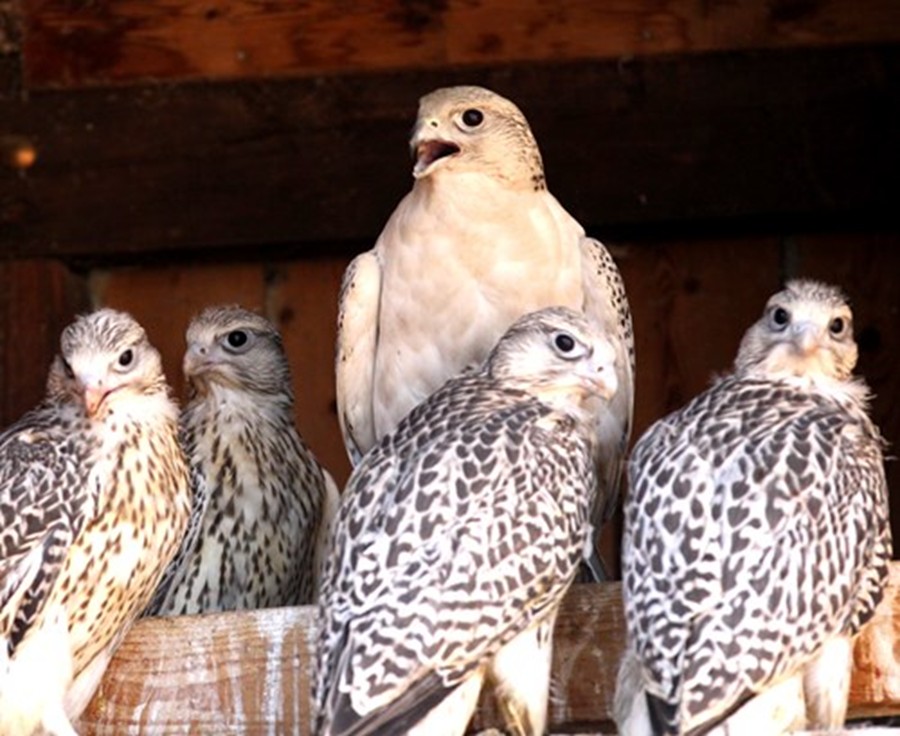
(EN sexual dimorphism (reversed size dimorphism))
Differences between male and female of the same species. In most birds of prey the female is larger than the male (reversed size dimorphism).
See also: terts / tercel (han)
(EN sexual maturity)
The age at which a bird can breed. Large eagles often only become mature after several years.
See also: ynglepar
(EN leash)
The strap or line that ties the bird to its block, bow perch or the glove. It is threaded through the swivel.
See also: dråle (svirvel), blok, bue / høgebue
Falconers' term for falcons. They have long, pointed wings and typically take their quarry in the air.
See also: kortvinger og bredvinger, falk
(EN lifespan)
How old a bird can live to be. In human care, birds of prey often live longer than in the wild.
Read more: Fuglenes alderdom
Sources: CORN
(EN alula)
A small group of stiff feathers on the wing's 'thumb' that helps the bird control the airflow at low speed.
See also: svingfjer
(EN creance /ˈkriːəns/)
A long, light line of 20–30 metres on which the bird is flown before it is ready to fly free. Older and international word: creance.
See also: langrem, at flyve frit
(EN lure)
A dummy of leather or a pair of wings, often garnished with meat, swung on a cord to call the bird back and to train it.
Word history: Lure was originally a falconry word: Anglo-French lure, Old French loirre, from a Germanic source; related to German Luder (Etymonline).
First recorded: Early 14th century (Etymonline).
Read more: Hvornaar traener i egentlig jeres fugle og hvor tit
See also: falkelokke, dummy (kaninlokke)
(EN weathering ground)
An outdoor area where the bird sits on its block or bow perch and gets fresh air, sun and access to a bath.
Sources: MA
(EN silent flight)
Owl feathers have soft, fringed edges that muffle the sound of the wingbeats.
See also: ugle
Sources: CORN
(EN magnetoreception)
Many migratory birds can orient themselves by the Earth's magnetic field.
Read more: Fuglenes magnetiske sans en naturlig gps
See also: træk
Sources: CORN
(EN anklet, bracelet)
A broad leather cuff around the bird's leg in the Aylmeri system. The strap passes through a grommet in the cuff.
See also: sko, aylmeri-sko
(EN mews /mjuːz/)
English falconry word for the room or aviary where the birds are kept, especially during the moult.
Word history: From Old French mue 'cage for hawks', from muer 'to moult'. London's Royal Mews stood where the king's hawks were kept; the word later came to mean stables (Etymonline).
First recorded: Late 14th century (Etymonline).
(EN beak, bill)
The hooked beak of a bird of prey is used to tear food apart, not to strike its quarry.
Read more: Naebbet fuglens vaerktoej vaaben og visdom
See also: næbtand (falketand), vokshud
(EN tomial tooth)
A small tooth-like notch on the upper beak of falcons. It helps the falcon dispatch its quarry quickly with a bite to the neck.
Read more: Naebbet fuglens vaerktoej vaaben og visdom
(EN captive breeding)
Planned breeding of birds of prey in human care, for example for falconry or release projects. The Peregrine Fund has bred and released many peregrines.
Read more: Fra aeg til falk
See also: prægning, vandrefalk
Sources: PF
(EN imprinting)
Early, rapid learning by which a young bird learns who it belongs to. A bird imprinted on people regards humans as its own kind.
Read more: Fra aeg til falk
See also: redeunge (eyass), unge
(EN on the fist)
Having the bird sitting on the glove. Every morning the falconer takes the bird on the fist and checks its straps at the same time.
See also: handske / falkonerhandske
(EN nest)
The place where the bird lays its eggs and raises its young. Falcons build no nest but lay their eggs on a cliff ledge or in other birds' nests.
Read more: Et sjaeldent syn i kongeoernens rede
A ledge in the aviary where the bird can lay and incubate its eggs. It is used especially for species that breed on cliff ledges.
Sources:
(EN eyass (eyas) /ˈaɪəs/)
Falconers' term for a bird raised by people from the nestling stage.
See also: unge
(EN predator–prey relationship)
The interplay between hunter and hunted. Birds of prey often take weak or sick animals and influence prey populations.
See also: bytte / vildt, fødekæde / toprovdyr
Sources: PF
(EN bird of prey, raptor)
A bird that hunts other animals and has a hooked beak and strong feet with talons: eagles, buzzards, hawks, kites, vultures and falcons. Whether owls are included depends on the definition.
Read more: Ugler er ikke rovfugle, Rovfugle i danmark saadan kender du dem fra hinanden
(EN incubation period)
The time from the start of incubation until the eggs hatch. It varies between species.
Read more: Aeg livets lille mestervaerk
(EN hovering)
When the bird 'stands still' in the air with rapid wingbeats, like the kestrel watching for mice.
See also: svæveflugt
(EN glove ring)
A metal ring on the glove to which the leash can be tied as an extra safeguard.
See also: handske / falkonerhandske
Sources: MA
A short line attached to the glove and the bird as an extra safeguard. It resembles the slip line but has a quite different purpose: the bird must not be able to fly off.
See also: slipline, handske / falkonerhandske
Sources:
(EN jesses /ˈdʒɛsɪz/)
Leather straps around the bird's legs (internationally: jesses), by which the falconer holds the bird. When the bird is flown free, slitless jesses are used so that nothing can snag.
Word history: Jess comes from Old French jes, plural of jet 'a throw', from Latin iactus (Etymonline).
First recorded: Mid-14th century (Etymonline).
See also: manchet, dråle (svirvel), langrem, aylmeri-sko
(EN slip line)
A short, thin cord through the eyelets of the anklets, so the falconer can quickly release the bird from the glove when hunting.
See also: handske / falkonerhandske, sko
Sources: MA
(EN telemetry)
A small radio or GPS transmitter on the bird. If the bird flies far away, the falconer tracks the signal with a receiver and finds it again.
See also: bjælde
Sources: MA
(EN tail feathers (rectrices))
The large tail feathers the bird uses to steer and brake. German falconry language calls the tail 'Stoß' or 'Staart'.
See also: svingfjer
(EN stoop)
The falcon's steep dive at its quarry with folded wings. The peregrine is known as the fastest animal on Earth in its stoop.
Read more: Styrtdyk flyv som verdens hurtigste dyr
See also: at vente kredsende, vandrefalk
Dogs are often used when hunting with birds. A pointing dog points to where the quarry lies and gives plenty of time; a flushing dog puts the quarry up and suits hawks, which are sprinters.
See also: falkejagt / falkoneri, kortvinger og bredvinger
Sources:
(EN flight feathers (remiges))
The large wing feathers that give lift and thrust. They are divided into primaries on the outer wing and secondaries on the inner wing.
Read more: Aerodynamik og flyvning
See also: styrefjer / halefjer, fældning
(EN soaring, gliding)
Flight without wingbeats, using updrafts and thermals to save energy.
Read more: Aerodynamik og flyvning
See also: termik / termisk opvind
(EN tarsus)
The lowest, usually unfeathered part of the leg above the toes. On falcons, the jesses and the ring sit here.
See also: sko
(EN thermal)
Columns of rising warm air in which large birds of prey in particular can soar without flapping.
Read more: Termikflyvning svaev som en andeskondor
See also: svæveflugt, træk
(EN territory)
The area a pair defends against others of its kind, especially in the breeding season.
Word history: From Latin territorium, from terra 'earth' (DDO).
See also: ynglepar
(EN tiercel (tercel) /ˈtɪəsəl/)
Falconers' term for the male, which in many birds of prey is about a third smaller than the female. The English word tercel is also used in Danish.
Word history: Tiercel goes back to Latin tertius 'a third' (DFO).
See also: kønsdimorfi, falk
(EN trust, bond)
The foundation of falconry: the bird returns because it has learned that the falconer is safe and rewards it.
Read more: Falkoner paa rovfuglenes praemisser
See also: at mande, indkald (at kalde fuglen ind)
(EN migration)
The regular movement of birds between breeding and wintering areas. Many birds of prey migrate over land, using rising air.
Read more: Fuglenes magnetiske sans en naturlig gps
See also: termik / termisk opvind
(EN adult plumage)
A bird in adult plumage, as opposed to a young bird in juvenile plumage.
(EN fledging)
When the young bird leaves the nest and starts to fly. The parents often keep feeding it for some time afterwards.
See also: unge
(EN owl)
Nocturnal or crepuscular hunters with forward-facing eyes, superb hearing and silent flight. Owls are not closely related to the diurnal birds of prey, even though they look similar.
Read more: Ugler er ikke rovfugle, Ugleoererne kan du finde musen i moerket
See also: rovfugl
(EN chick, nestling)
A bird that cannot yet fly. Young birds of prey hatch covered in down and are fed by their parents.
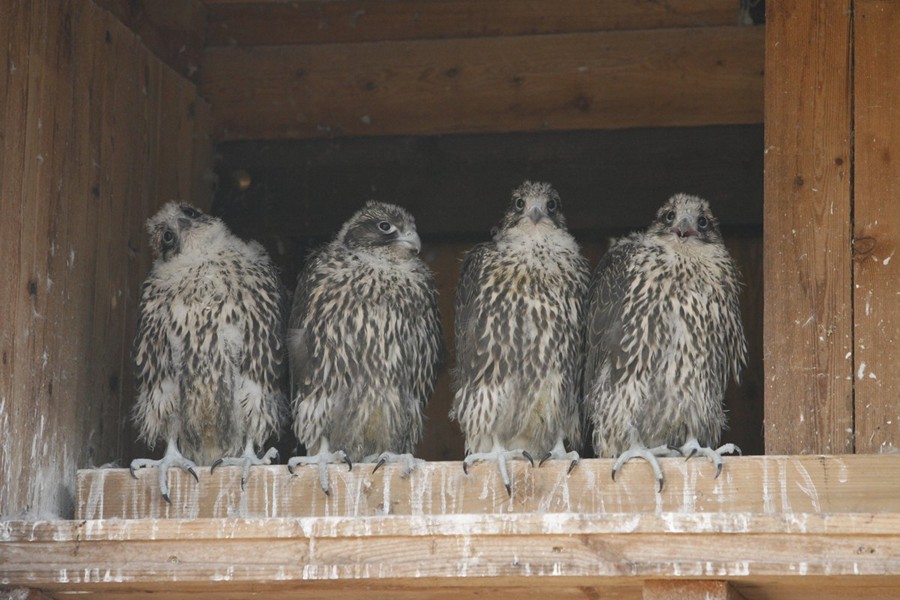
Read more: Fra aeg til falk
See also: dun, redeunge (eyass), kuld
(EN juvenile, immature)
A bird that can fly but does not yet have adult plumage. In many eagles this takes several years.
See also: fjerdragt
(EN peregrine falcon)
A widespread falcon known for its fast stoops. It has recovered after a decline in the 20th century.
Read more: Vandrefalk falco peregrinus, Vandrefalken jordens hurtigste levende vaesen
Sources: PF
(EN scientific name)
A two-part Latin name (genus and species), such as Falco peregrinus. It is the same in every language.
See also: falk
Sources: CORN
(EN wingspan)
The distance from wingtip to wingtip with the wings outstretched.
See also: svingfjer
(EN cere /sɪə/)
The bare, often yellow skin at the base of the beak where the nostrils are.
See also: næb
(EN aviary)
A spacious, covered enclosure where the bird can move freely and be left in peace.
Word history: From French volière, from voler 'to fly', Latin volare (DDO).
See also: mews (fældningsrum), lufteplads
Sources: DDO
(EN weighing, scales)
Daily weighing on accurate scales is the falconer's most important tool for following the bird's condition.
See also: flyvevægt
Sources: MA
(EN buzzard (US: hawk, e.g. Harris's hawk))
Broad-winged birds of prey that often soar or sit watching, such as the common buzzard. The Harris's hawk is popular in falconry.
See also: kortvinger og bredvinger
(EN breeding pair)
A male and female breeding together. Many large birds of prey pair for life.
See also: territorium, kuld
(EN egg)
Birds of prey lay only a few eggs at a time. The egg protects and nourishes the embryo until the chick hatches.
Read more: Aeg livets lille mestervaerk, Fra aeg til falk
(EN eyes, vision)
Birds of prey have very sharp vision and large, forward-facing eyes that give good depth perception.
Read more: Rovfuglenes oejne naturens mest avancerede synsorganer, Rovfuglenes sanser
See also: ugle
Sources: CORN
(EN eagle)
Large, powerful birds of prey with broad wings, such as the white-tailed eagle and golden eagle.
Read more: Havoern haliaeetus albicilla, Kongeoern
No entries match your search.
Falconry is a shared cultural heritage of many countries. Here are some of the key words in Arabic, Chinese, Japanese and Spanish, with the standard romanisation (pinyin, Hepburn, Spanish spelling) and IPA in small print. We only include words we have found in reliable sources. The Arabic forms follow the Gulf dialect.
| Concept | Arabic | Chinese | Japanese | Spanish |
|---|---|---|---|---|
| falcon | صقر saqr (golf: sagr) /saqr/ generic word, strictly the saker [ARS] | 猎鹰 lièyīng /lje˥˩ iŋ˥/ [ZH1] | 隼 hayabusa /hajabɯsa/ strictly the peregrine [SUWA] | halcón halcón /alˈkon/ [ES1] |
| falconer | صقّار saqqār /saqˈqaːr/ [UAE] | 驯鹰人 xùnyīngrén /ɕyn˥˩ iŋ˥ ʐən˧˥/ [ZH2] | 鷹匠 takajō /takadʑoː/ [SUWA] | halconero / cetrero halconero, cetrero /alkoˈneɾo, θeˈtɾeɾo/ [ES1] |
| falconry | بيزرة bayzara /ˈbajzara/ [EFC] | 驯鹰习俗 xùnyīng xísú /ɕyn˥˩ iŋ˥ ɕi˧˥ su˧˥/ literally 'the custom of training hawks' (Kyrgyz tradition) [ZH1] | 鷹狩 / 放鷹術 takagari, hōyōjutsu /takaɡaɾi/ [SUWA] | cetrería cetrería /θetɾeˈɾi.a/ [ES1] |
| glove | منقلة mangalah (golf) /ˈmanɡala/ arm sleeve, used instead of a glove in the Gulf [ARS] | 皮手套 pí shǒutào /pʰi˧˥ ʂoʊ̯˨˩˦ tʰaʊ̯˥˩/ leather glove [ZH2] | 弓掛 / 鞢 yugake, egake /jɯɡake/ [IAFJP] | guante / lúa guante, lúa /ˈɡwante, ˈlu.a/ [ES1] |
| hood | برقع burqaʿ (golf: burgu) /ˈburqaʕ/ [UAE] | not documented | 隼頭巾 hayabusa-zukin /hajabɯsa dzɯkʲiɴ/ falcon hood [SUWA] | capirote / caperuza capirote /kapiˈɾote/ [ES3] |
| jesses | سبوق sabbūq (golf: sbug) /sabˈbuːq/ [UAE] | not documented | 足革 ashikawa /aɕikawa/ [IAFJP] | pihuelas pihuelas /piˈwelas/ [ES3] |
| leash | مربط marbaṭ /ˈmarbatˤ/ [ARS] | not documented | 大緒 ōo /oːo/ [IAFJP] | lonja lonja /ˈloŋxa/ [ES3] |
| swivel | not documented | not documented | 旋子 motooshi /motooɕi/ [IAFJP] | tornillo / destorcedor tornillo /toɾˈniʎo/ [ES3] |
| lure | تلواح tilwāḥ / milwāḥ /tilˈwaːħ/ [UAE] | 假兔子 jiǎ tùzi /tɕja˨˩˦ tʰu˥˩ tsɨ/ only 'rabbit lure/dummy' [ZH2] | not documented | señuelo señuelo /seˈɲwelo/ [ES2] |
| block / bow perch | وكر wakr /wakr/ block [UAE] | not documented | 架 hoko /hoko/ perch [IAFJP] | alcándara alcándara /alˈkandaɾa/ perch [ES3] |
| hawk | باز bāz /baːz/ goshawk [ARS] | 鹰 yīng /iŋ˥/ generic 'hawk/eagle' [ZH1] | not documented | azor azor /aˈθoɾ/ goshawk [ES1] |
Not documented (left out):